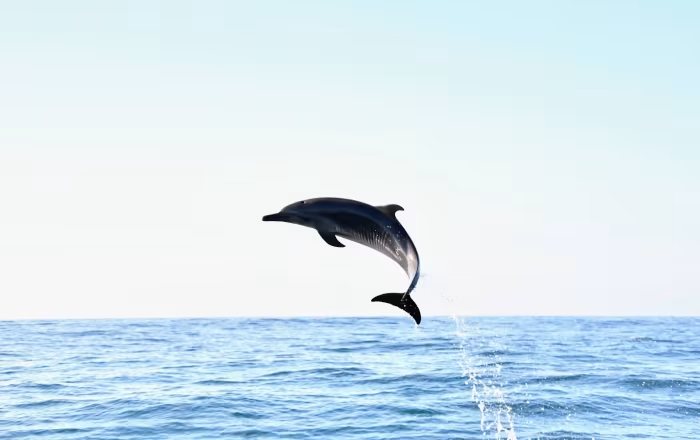
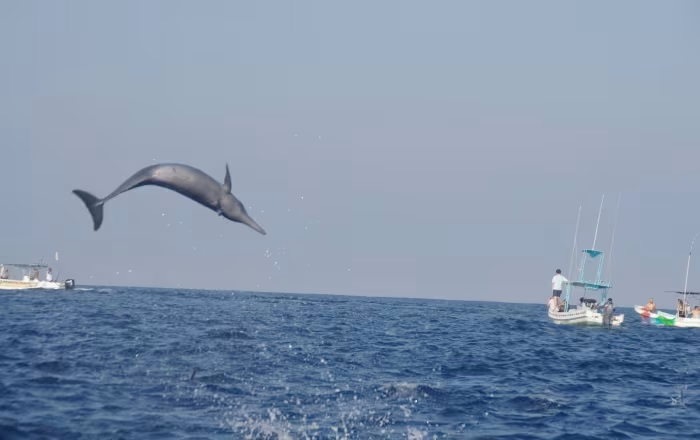
Pantropical spotted dolphins: the spinners' traveling companions

You are watching spinner dolphins, and then one surfaces beside them that looks a little different: a bit sturdier, with pale flecks on a dark back and a white tip on its beak. That is very likely a pantropical spotted dolphin (Stenella attenuata), the third regular off Puerto Escondido and an easy one to miss, because in a mixed group it is tempting to count every fin as a spinner.
Pantropical spotted dolphin vs spinner dolphin: the quick answer
Look for spots and a white beak tip on the first, and a very long thin beak and a rotating jump on the second.
- Size: NOAA Fisheries gives about 6 to 7 feet (1.8 to 2.1 meters) for pantropical spotted dolphins, with adults around 250 pounds (some 110 kg). Spinners run about 4 to 7 feet (1.2 to 2.1 meters) and are usually lighter.
- Pattern: an adult spotted dolphin has a dark cape and speckles. A spinner often shows three bands: dark back, gray side, white belly.
- Beak: both are slender. The spinner's looks especially long and fine; the spotted dolphin's often ends in a white tip.
- Dorsal fin: usually curved back on a spotted dolphin. On many spinners in this part of the Pacific it stands as an upright triangle.
- Jumps: both leap. Repeated spinning around the body's own axis is the spinner's signature.
Where did the spots go?
Do not expect every spotted dolphin to be spotted. According to NOAA Fisheries, they are born without spots and gain them with age, until older animals can be almost covered in overlapping speckles. A single group can include plain gray youngsters, lightly freckled juveniles and heavily marked adults.
How strongly spotted the adults are also varies from one population to another. The practical advice: do not rule out the species because the first animal you see is plain. Wait for a few more to surface, and check the beak and the dark cape.
Why do spotted and spinner dolphins travel together?
Mixed groups of these two are well known in the eastern tropical Pacific. They are close relatives, in the same genus, but they do not live in quite the same way. Spinners feed mostly at night on small fish, shrimp and squid that rise from deep water, then spend part of the day resting and socializing. Spotted dolphins also take squid and fish, including prey from the middle depths, and NOAA notes night foraging for them too.
So what is the point of company? The explanation researchers tend to favor is safety: more animals means more eyes and ears watching for sharks and other predators, and any one dolphin is less likely to be the target. Feeding may play a part in some places, but a shared meal does not seem to be the whole story. Nobody can tell you why a particular group is mixed on a particular morning.
Offshore, some tuna also gather beneath spotted dolphins. Fishing fleets learned to set nets around the dolphins to catch the tuna, and very large numbers of dolphins died, spinners among them. NOAA still lists the northeastern offshore stock of spotted dolphins as depleted.
What has been recorded on the Oaxaca coast?
Researchers Meraz and Sánchez-Díaz surveyed marine mammals from the Huatulco bays to La Escobilla beach between 1999 and 2004 and published the results in 2008. In their work the pantropical spotted dolphin was the most abundant species and turned up on almost every outing, in groups that could reach 100 animals or more, often moving or feeding in subgroups of 5 to 20. These were often accompanied by a much smaller number of spinners and bottlenose dolphins. The team also recorded calves under a meter long, which suggests the species breeds in the area.
Read that with care. It was a set of 30 boat surveys, more than twenty years ago, on the coast east of Puerto Escondido. It does not predict what you will see tomorrow. On our morning tour, spinners are the dolphins we mostly see.
How to pick them out from the panga
- Scan the whole group. Do not stop at the first species you identify. Look for animals with a different fin shape or a sturdier body.
- Watch the front end. A white-tipped beak breaking the surface is one of the quickest clues.
- Photograph, then zoom. Speckles that are invisible from the boat often show up in a sharp frame. See our dolphin photography tips.
- Mind the light. Low sun and wet skin make glare that looks like spots, or hides them. Check more than one photo.
Will you see spotted dolphins on the tour?
Possibly. No captain can choose the species, and no wildlife trip can promise a sighting. The sunrise tour finds dolphins of one kind or another on more than 95% of departures; we have no separate figure for spotted dolphins. The trip lasts about 3 hours on a traditional panga, with hotel pickup at 6:30 AM and return by about 10:00 AM, from $895 MXN per person.
Protected, mixed group or not
Mexico lists both the pantropical spotted dolphin and the spinner dolphin in NOM-059-SEMARNAT-2010 as species under special protection. On our tour nobody swims with, touches or feeds them, and the captain does not chase or cut through a group to get a closer look. If they come to the bow, it is their choice. Read more about responsible dolphin watching.
Common questions
Can spotted dolphins spin?
They are active leapers, but the multiple rotations people travel to see are the spinner's trademark.
Can a dolphin without spots still be a spotted dolphin?
Yes. Calves have none, and young animals may have only a few.
For the spinning half of the partnership, read why spinner dolphins leap and spin.
Cover photo: pantropical spotted dolphin off the coast of Costa Rica (not Oaxaca), by Julio-César Chávez, Wikimedia Commons, CC BY 4.0, resized and cropped. Size, diet and tuna fishery information: NOAA Fisheries on the pantropical spotted dolphin and the spinner dolphin.