Bottlenose dolphins off Puerto Escondido: meet the toninas

Ask a fisherman on Bahía Principal what he saw this morning and you may hear one word: toninas. In Mexico that is the everyday name for the bottlenose dolphin (Tursiops truncatus), the big gray dolphin most people picture when they hear the word "dolphin". Off Puerto Escondido it shares the water with a very different neighbor, the spinner dolphin, and once you know what to look for you can usually tell them apart from the boat.
Bottlenose dolphin vs spinner: the quick answer
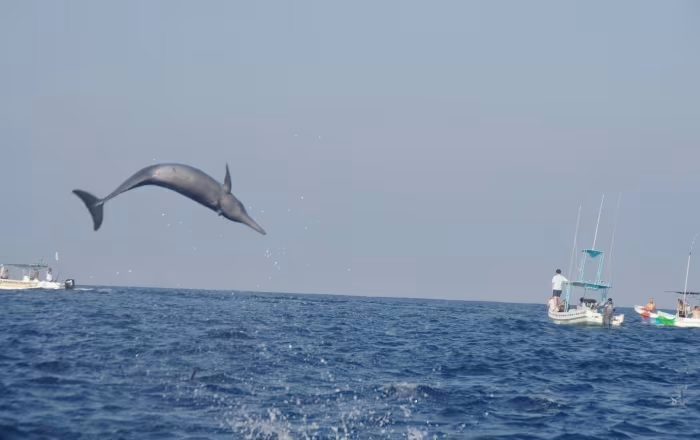
The bottlenose is the heavyweight with the short, thick snout. The spinner is the slim one with the long, narrow beak that throws itself into the air and rotates.
- Size: NOAA Fisheries gives about 1.8 to 4 meters (6 to 13 feet) for bottlenose dolphins, against roughly 1.2 to 2.1 meters (4 to 7 feet) for spinners.
- Snout: short and stubby on a bottlenose, long and slender on a spinner.
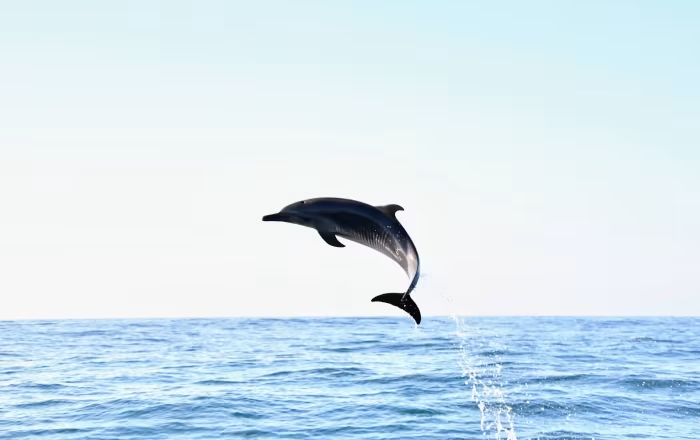
- Color: a bottlenose is fairly plain gray, darker on the back and pale underneath. Spinners often show three bands: a dark cape, a lighter gray side and a white belly.
- Dorsal fin: prominent, curved and set mid-back on a bottlenose. Many spinners have a more upright, triangular fin.
- Style: spinners are the acrobats. Bottlenose dolphins leap too, but they do not specialize in the spinning jump.
One caution: size is hard to judge at sea with nothing to compare it to. The snout and the fin are better clues, and a photo helps settle arguments afterwards.
What do we know about toninas on this coast?
Less than you might think. One useful source is a study by researchers Meraz and Sánchez-Díaz, published in 2008 in the Revista Mexicana de Biodiversidad. They recorded marine mammals along the central coast of Oaxaca, from the Huatulco bays to La Escobilla beach, between 1999 and 2004.
In their surveys the bottlenose dolphin had the second-highest share of sightings, but a modest one, 7.7 percent. It was seen from January to August, in small groups of 2 to 13 animals, and always together with pantropical spotted dolphins. The spotted dolphin was the most abundant species they met.
Keep the limits in mind. That work is more than twenty years old, it covered the stretch of coast east of Puerto Escondido, and the months when a species was recorded are not a calendar of when you will see it. The authors suggested bottlenose dolphins may live in the area year round, in smaller numbers, but did not prove it.
How bottlenose dolphins make a living
Bottlenose dolphins are generalists. They eat fish, squid and crustaceans, and they are flexible about how they get them. Some hunt alone; others work as a team, herding a school of fish and taking turns charging through it. They find prey by listening and by echolocation, sending out clicks and reading the echoes. They do not chew: the teeth grip, and the fish goes down whole, usually head first.
That differs from the typical spinner routine. In well-studied places, spinners feed mostly at night on small prey that rises from deep water, and spend part of the day resting and socializing.
Bottlenose groups are also fluid. They often split and re-form, so the same animal may be in a pair one day and in a larger gathering another. They are long-lived too: at least 40 years, and some females 60 or more.
How to spot a tonina from the panga
- Check the edges of a bigger pod. A few noticeably larger, plainer dolphins among smaller ones are worth a second look.
- Watch the head as it surfaces. A bottlenose shows a rounded forehead with a clear crease before the short snout.
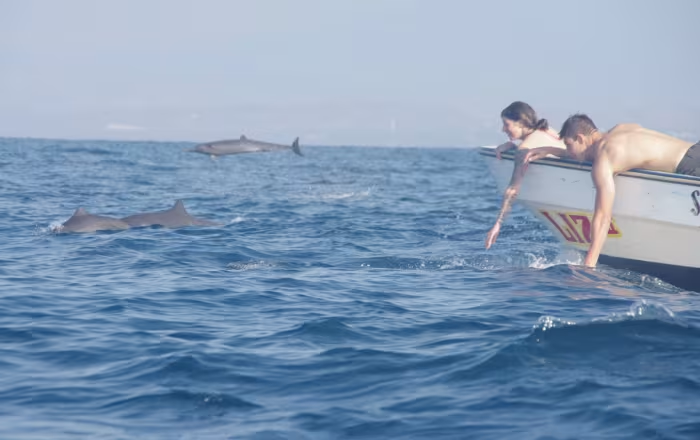
- Look near the bow. They sometimes ride the pressure wave in front of a moving boat. Our guide explains why dolphins ride the bow wave.
- Shoot in bursts. One sharp frame of the head or dorsal fin is usually enough to identify the species later.
Will you see bottlenose dolphins on the tour?
Maybe. Spinner, bottlenose and pantropical spotted dolphins are all found off Puerto Escondido, but no captain can order up a species, or promise any wild animal at all. The sunrise tour sees dolphins of one kind or another on more than 95% of departures; mornings with toninas specifically are fewer, and we do not have a figure for them.
The trip lasts about 3 hours on a traditional panga, with hotel pickup at 6:30 AM and return by about 10:00 AM, from $895 MXN per person. Life jackets and bottled water are included. If you want the full picture before booking, read what a sighting rate really means.
Toninas and the law
Mexico lists the bottlenose dolphin in NOM-059-SEMARNAT-2010 as a species under special protection. Being a familiar dolphin does not make it fair game for close contact. On our tour nobody swims with, touches or feeds them. The captain lets the animals decide the distance and never chases them, as described in our notes on responsible dolphin watching.
Common questions
Is a tonina a dolphin?
Yes. In Mexico "tonina" usually means the bottlenose dolphin, although some people use it loosely for dolphins in general.
Which is more common on the tour, spinner or bottlenose?
On the morning tour we mostly see spinner dolphins. Bottlenose dolphins tend to show up in smaller numbers.
Are bottlenose dolphins bigger than spinners?
Clearly. An adult bottlenose can weigh several times as much as a spinner.
For the third regular, the speckled one, see our guide to the dolphin species of Puerto Escondido.
Cover photo: bottlenose dolphins at Isla Socorro, in Mexico's Revillagigedo Archipelago (not Oaxaca), by Talia Cohen, Wikimedia Commons, CC0, resized and cropped. Size, diet and lifespan data: NOAA Fisheries on the bottlenose dolphin and the spinner dolphin.