Mobula rays: why they leap out of the water off Oaxaca

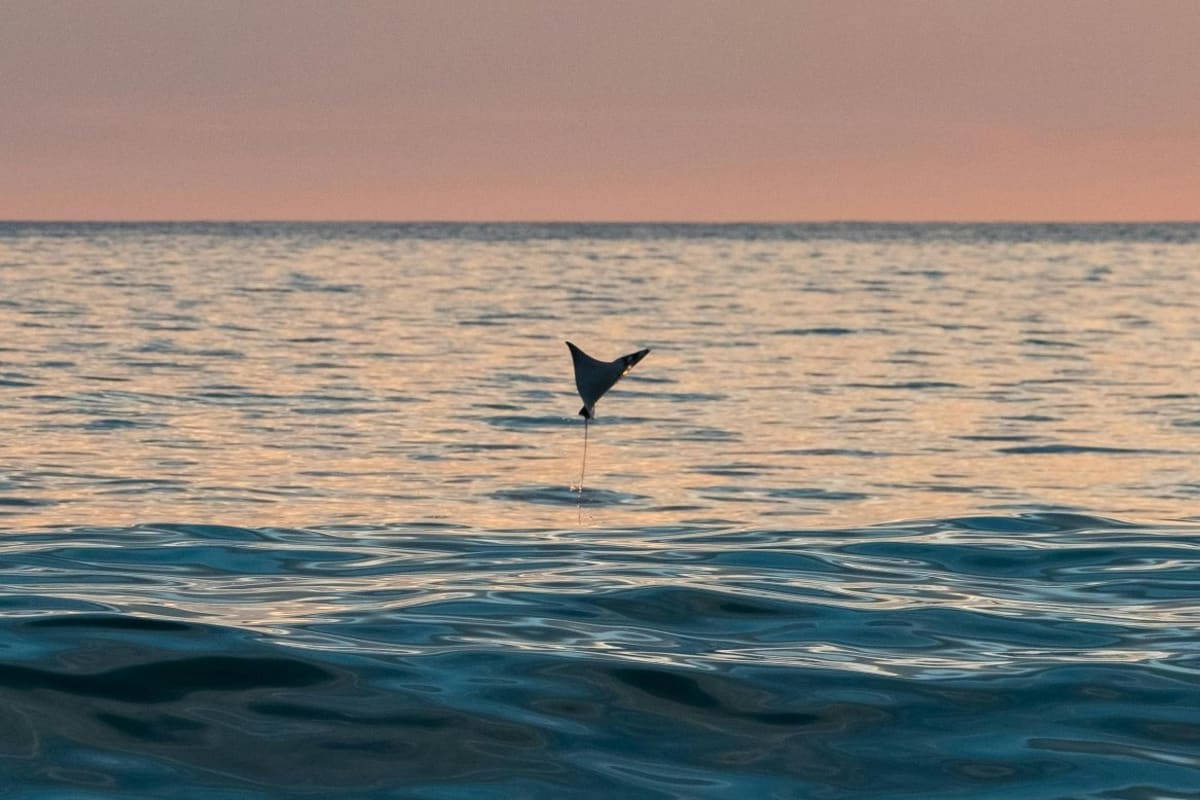
You usually hear it first: a flat, wet slap somewhere off the side of the boat. Then a dark triangle shoots out of the sea, flaps once or twice in the air and drops back with another smack. So why do mobula rays jump? The honest answer is that nobody has proven it yet. There are several good ideas, and more than one may be true.
First, what is a mobula?
Mobulas, also called devil rays, are the smaller relatives of the giant manta. In fact, scientists now place mantas in the same genus, Mobula. Several species live in the eastern Pacific. One of the best known for jumping is Munk's devil ray (Mobula munkiana), which reaches about 1.1 meters across and is found from the Gulf of California to Peru. It can gather in very large schools.
They feed on plankton and other tiny prey that they filter from the water. When people here say they saw a "little manta jumping", this is almost always the animal they mean. It is not the same as the spotted eagle ray, which has a back covered in white spots.
Why do mobula rays jump? The main theories
1. Communication
The landing is loud, and sound travels well underwater. A slap on the surface may tell other rays where the group is, or draw more of them in. Researchers who study these rays often mention this as one of the likelier explanations, but it is still a hypothesis.
2. Courtship
Mobulas gather to mate, and Munk's devil rays have been documented courting in slowly turning groups. Leaping could be part of how they show off or get a mate's attention. What is missing is solid proof linking a particular jump to a successful pairing.
3. Getting rid of hitchhikers
Rays can carry parasites, and remoras often stick to them. Hitting the water hard might knock some of these off. It is a reasonable idea, though it would not obviously explain why so many animals jump at once.
4. Feeding or play
Some people suggest the slaps help while a group is feeding, and others that the rays simply do it as play. Neither has been demonstrated. A wild animal can also have a reason we have not thought of.
What a jump looks like from the boat
A jump is over in a second or so. Some rays go up flat and belly-flop, others flip over in the air. Often one leap is followed by several more in the same area, so if you missed the first one, keep your eyes there.
- Listen. The slap often gives the position away before you see anything.
- Scan wide. Jumps can happen far from the bow, not where everyone is looking.
- Use burst mode, or simply record video. By the time you react to a leap, it is usually over. Our photography tips work for rays too.
- Look for fins. When mobulas swim at the surface, their wing tips can poke out like two small fins moving together.
Can you see mobula rays off Puerto Escondido?
Yes, though never on a schedule. April to June often brings frequent manta and mobula sightings here, when the water is warm and clear, as we explain in our season guide. At other times of year they can turn up too, or not at all. They are wild animals moving with their food.
The sunrise tour is a dolphin trip first: about 3 hours on a traditional panga, with hotel pickup at 6:30 AM and return by about 10:00 AM, from $895 MXN per person. Dolphins are spotted on more than 95% of departures. A jumping ray is a bonus, and no captain can promise one.
Are mobulas dangerous?
Watching them from a boat is not a risk: they are plankton feeders with no interest in people. The vulnerable side is theirs. Mobulas reproduce slowly, usually one pup at a time, and they get caught in fishing nets. The IUCN Red List rates Munk's devil ray as Vulnerable, and some of its relatives as Endangered. In Mexico, the federal standard NOM-029-PESC-2006 bans catching and keeping manta and mobula rays.
That is why the right way to watch them is from a distance, without chasing a school, driving through it or jumping in on top of them. The same attitude guides how we approach every animal, as described in our notes on responsible wildlife watching.
Common questions
Do mobula rays jump to escape predators?
It is a fair guess, since orcas are known to hunt devil rays. But rays also leap when no predator is visible, so it is unlikely to be the whole story.
Are mobulas and manta rays the same thing?
They are close relatives in the same genus. The giant oceanic manta is far bigger and is an occasional sighting here. The jumpers you are most likely to notice are the smaller devil rays.
For everything else that can show up between dolphin pods, read marine wildlife beyond dolphins.
Cover photo: a mobula ray leaping at Cabo Pulmo, Baja California Sur (not Oaxaca), by Nick Bonzey, Wikimedia Commons, CC BY-SA 2.0, resized and cropped.