Humpback whale song: why males sing off the Mexican Pacific

While you are eating breakfast on a winter morning in Puerto Escondido, a male humpback somewhere offshore may be hanging head-down in the water, motionless, producing one of the most complex sounds in the animal world. It will probably keep at it for hours. Humpback whale song is one of the best-known things about these animals, and also one of the least settled.
Here is what we know, what researchers still debate, and what it means for a morning on the water off the Oaxacan coast.
Only the males sing
Of everything about the song, this is the most solid fact: the singers are males. Females and calves make other sounds, but the long, patterned songs come from males, and they are tied to the breeding season. That is why the song belongs to the same months as our whale season: humpbacks that spend the summer feeding in cold northern waters move to warm tropical seas in winter to mate and give birth. The Mexican Pacific is one of the main breeding areas in the North Pacific, and the Oaxacan coast is part of that winter range. Our humpback season guide has the calendar.
Singing is mostly a winter, warm-water activity. In the cold feeding grounds, whales are usually quiet by comparison, though some song has been recorded there too, especially during migration.
What a humpback song is made of
Researchers describe the song like a very long piece of music with nested parts:
- Units: single sounds, such as a moan, a cry or a chirp.
- Phrases: a short series of units repeated a few times.
- Themes: groups of similar phrases.
- The song: several themes sung in a set order. A full song usually lasts somewhere around 10 to 20 minutes, and the whale then starts again, often for hours.
Much of the sound is low, below what most people can hear well, and it carries a very long way underwater. The singer is usually a lone male, often hanging head-down at some depth, and he surfaces to breathe and goes back to it.
All the males sing the same song, and it keeps changing
This is the part that surprises people. Within a population, males sing essentially the same song at any given time, and that song slowly changes over a season and from year to year. Whales pick up new elements from each other, and the whole group shifts together. Songs from different ocean basins differ, and there are documented cases of new song types spreading from one population to another across the Pacific, which scientists see as a rare example of cultural transmission in a wild animal.
So the song is not a fixed call like a bird's alarm note. It is learned, shared and constantly evolving.
What is the song for?
Honestly, nobody knows for certain, and a few explanations are still argued over.
1. Attracting females
The classic idea is that males sing to advertise themselves to females, a bit like a bird's song in spring. It fits the timing and the fact that only males sing, but the evidence that females choose mates by song is thin.
2. Dealing with other males
Another idea is that singing signals to rival males, helping to keep distance or sort out who is who in a crowded breeding area. Singers sometimes seem to react to other singers, and whales often stop singing when they join a group.
3. Something we have not thought of
The song may do more than one job, and some researchers suspect the function is not obvious from a human point of view. When a guide says "we don't really know," that is the accurate answer, not a dodge.
Can you hear it from the boat?
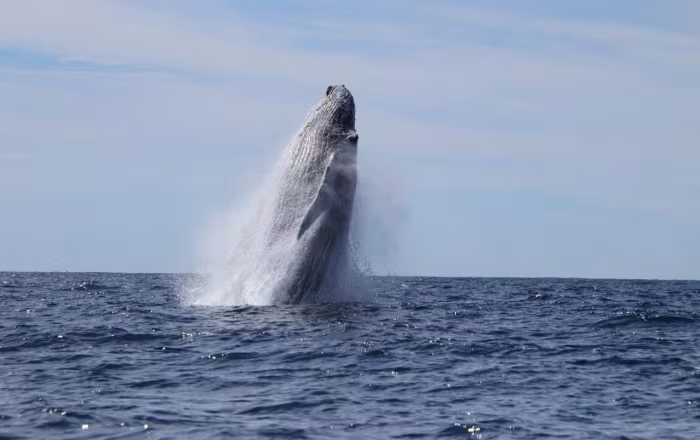
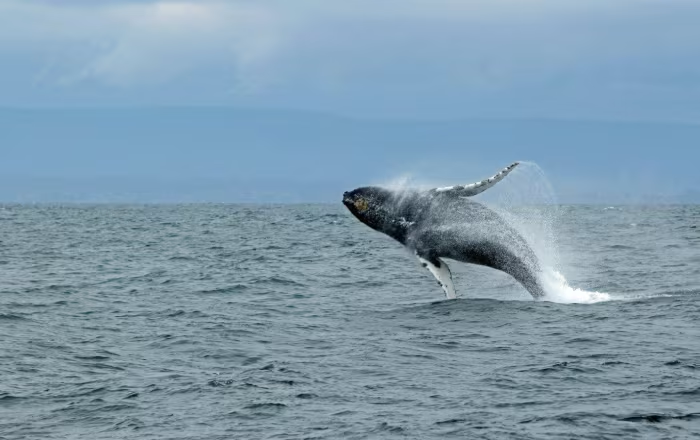
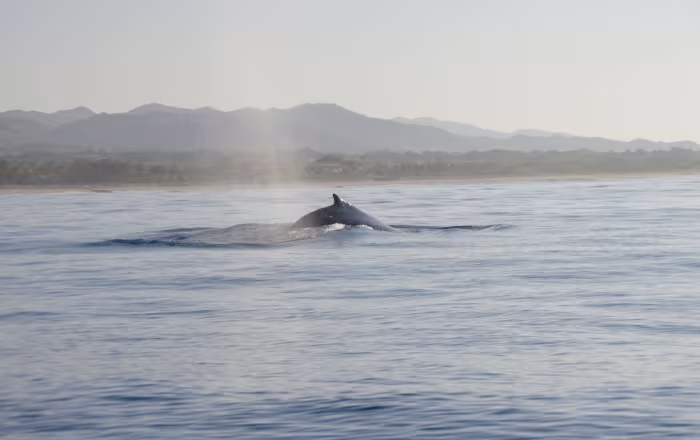
Almost certainly not, and we would rather say so than promise it. Humpback song travels well underwater, but from the deck of a panga you will hear the engine, the waves and the other passengers. Researchers use hydrophones, underwater microphones, to record it, and the recordings you may have heard come from those. What you can see from the boat is the rest of the winter show: blows, backs, tails and, with luck, a breach.
It is still worth knowing what is going on below. On a winter morning with whales around, a singer may well be working somewhere underneath you.
Do boats affect the singing?
Noise is a concern for whales that depend on sound, and studies in several parts of the world have found that humpbacks can change their calls when there is a lot of vessel noise. That is one of the reasons whale watching in Mexico is regulated by the federal standard NOM-131-SEMARNAT-2010, which sets minimum approach distances, limits how many boats can be near the same whales and for how long, and asks for extra care around mothers and calves. A good captain approaches slowly, slows the engine near whales and never chases. The rules are explained in our guide to whale watching rules in Mexico.
Will we see whales on the tour?
From November to March, humpbacks are a regular bonus on the sunrise tour at no extra cost, and the captain watches for blows the whole morning. Sightings vary a lot: some days a distant blow and a tail, other days a whale that stays around. No boat can guarantee whales. Dolphins are different: they live off Puerto Escondido all year and show up on most departures. The tour lasts about 3 hours, with hotel pickup at 6:30 AM.
Common questions
Do female humpbacks sing?
The long songs are sung by males. Females and calves do make other sounds, but they are not what researchers call song.
Why is it only in winter?
Because song is linked to breeding, and breeding happens in warm waters in winter. Peak months here are usually January and February, but the calendar shifts a little from year to year.
Is the song the same everywhere?
No. Populations in different ocean regions sing different songs, and each population's song keeps changing over time.
Can I hear whales if I get in the water?
Swimming with whales is not allowed in Mexico, and on our tour everyone stays on the boat. Any close approach is the whale's decision.
To plan around the season, start with our whale watching guide.