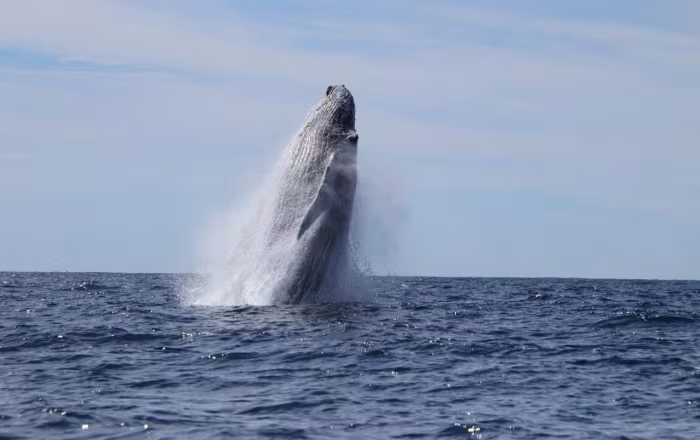
How close can boats get to whales? Mexico's whale watching rules explained
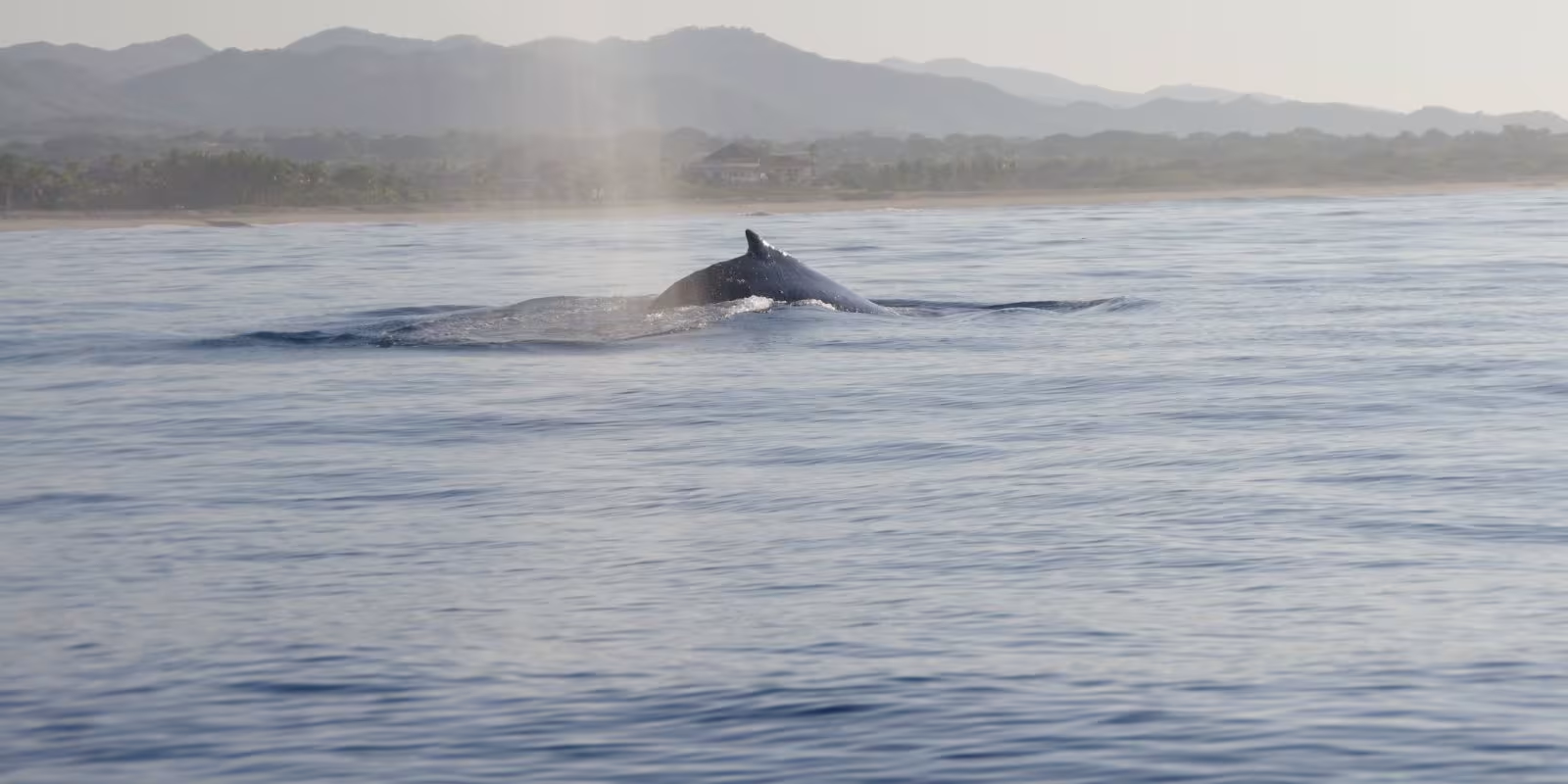
Every winter someone on the boat asks the same question when a humpback surfaces off the bow: can't we get a little closer? It is a fair question, and the answer is not up to the captain. In Mexico, whale watching is governed by a federal standard, NOM-131-SEMARNAT-2010, that sets distances, speeds, time limits and how many boats can be around the same whales. This guide explains those rules in plain English, so you know what a well-run whale encounter looks like and why the boat sometimes stays put while the whale moves on.
How close can boats get to whales in Mexico?
The short answer for the humpbacks you see off Puerto Escondido: 60 meters for a small boat. The standard divides boats by length, and the panga used on the sunrise tour falls in the small category.
- Small boats (under 10 m): 60 meters from humpbacks, gray whales, Bryde's whales, sperm whales and most other species.
- Medium and large boats (10 m and over): 80 meters for the same species.
- Blue and fin whales: more room, 100 meters for small boats and 120 meters for larger ones.
- Waiting zone: 240 meters. Boats that are not actively watching hold back at this distance.
Sixty meters sounds far on paper. On the water, with a 14-meter animal blowing a column of mist into the air, it feels close, and through a phone camera it looks closer still.
Four boats, thirty minutes
Distance is only one part of the rule. The standard also limits pressure on the animals over time:
- No more than four boats may stay around the same whale or group of whales. Any others wait at 240 meters until a spot opens up.
- A maximum of 30 minutes with the same whale or group in authorized viewing areas. After that, the boat moves on.
Thirty minutes is usually plenty. Humpbacks often dive for several minutes at a time, and a good captain uses the wait to read where the whale is heading rather than racing to where it went down.
How a boat is supposed to approach
This is the part most visitors never notice, and it is the part that matters most to the whale.
- From the side and behind. For whales on the move, boats approach on a diagonal from the rear flank and then run parallel to the animal's path. Never head-on, never cutting across in front.
- Slowly. Speed in whale watching areas is capped at under 5 knots, slower still inside the viewing zone, and never faster than the slowest whale. Sudden acceleration or braking is out.
- Engine in neutral when the whale stops. The idling engine lets the whale know exactly where the boat is. Captains may switch it off only to drop a hydrophone and listen to the whales sing.
- No sonar or fish finders to locate whales. The animals are found by eye: blows, splashes and birds.
Mothers and calves
The Oaxacan coast sees humpback mothers with young calves in the winter months, and the standard is strict about them. A boat must never come between a mother and her calf, and must not approach whales that are mating or giving birth. If whales start to show signs of disturbance, such as swimming away, diving for longer or breaking off feeding or nursing, the boat has to leave slowly. A calf that is pushed into constant diving can't rest or nurse, which is why you may see your captain back off even when the encounter seems to be going well.
What if the whale comes to you?
It happens. Occasionally a curious humpback swims toward a drifting boat or surfaces nearer than 60 meters on its own. The rule here is clear: the engine stays in neutral, the boat waits for the whale to move away, and then it leaves slowly, without sudden acceleration. Nobody chases it afterward. These are the encounters people talk about for years, precisely because the whale chose them.
What you can't do
NOM-131 bans swimming, diving and snorkeling with whales, fishing around them, feeding them and harassing them in any way, including trying to force contact. It also bans watching whales from helicopters and ultralight aircraft. The standard was written before consumer drones became common and does not mention them, but on a shared tour a buzzing drone over a whale is the opposite of what the rules are trying to achieve, so please leave it in the bag.
Whale watching as a business also needs a permit from SEMARNAT, Mexico's environment ministry, which sets the species, zones and season for each authorized boat. Authorized boats carry a distinctive marker issued with the permit.
Do the rules apply to dolphins?
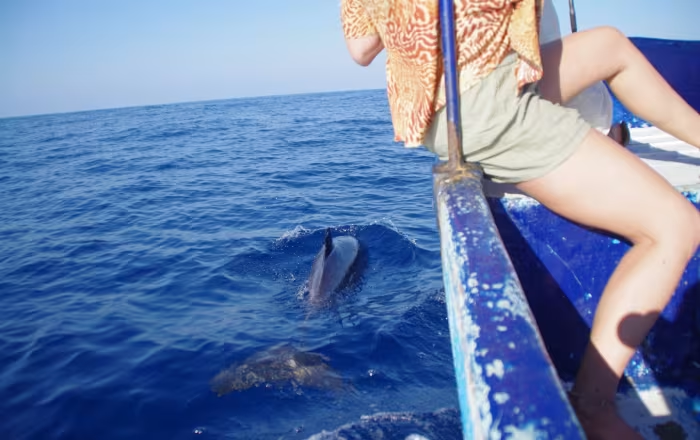
Not this specific standard. NOM-131 covers baleen whales (humpbacks, gray, blue, fin, Bryde's and the rest of that group) plus the sperm whale. Dolphins are protected under Mexican wildlife law in general, and swimming with or feeding wild dolphins is not allowed, but there are no separate dolphin distances written into this norm.
In practice our captains use the same logic with the dolphins: slow approach from the side, no chasing or splitting a pod, engine idled or cut so the animals decide how close they come. With dolphins, that often means they end up riding the bow a few meters away, by their own choice. Our guide to responsible dolphin watching explains how we handle those encounters.
Where these rules apply near Puerto Escondido
In 2019, SEMARNAT declared a whale watching zone of about 280 square kilometers off the coast between the municipalities of Santa María Colotepec and San Pedro Mixtepec, which is the stretch of sea right off Puerto Escondido. It was the second such zone in Oaxaca, after the one off Mazunte. Official season dates are published each year, and the whales themselves are on their own schedule: most years the first humpbacks show up in late November or December, and they are mostly gone by the end of March. Our humpback season guide covers the timing in detail.
How to tell a responsible tour from a bad one
You don't need to carry a tape measure. A few signs tell you most of what you need to know:
- The boat slows down well before reaching the whale, not right on top of it.
- It approaches from the side or behind, never straight at the whale's head.
- When other boats are already around the same animal, your captain waits his turn at a distance.
- The engine goes to neutral when the whale stops or comes closer.
- The boat leaves when the whale's behavior changes, even if the passengers want more.
If you see a boat racing toward a blow, cutting in front of a whale or hemming in a mother and calf, that is exactly what the standard prohibits. You can read the full text of NOM-131-SEMARNAT-2010 in the Diario Oficial de la Federación (in Spanish).
Quick answers
Can you swim with whales in Puerto Escondido?
No. Swimming and diving with whales are prohibited under NOM-131, and no legitimate tour in Oaxaca offers it.
Why didn't our boat go closer when other boats did?
Either those boats broke the rules, or they were already among the four allowed boats and yours was waiting its turn. Either way, holding back is the right call.
Can I see whales from the shore?
Yes, sometimes. In whale season, blows and breaches are visible from viewpoints and beaches along the coast, and the distance rules only apply to boats.
If the whales are the reason you are coming in winter, read our guide to whale watching in Puerto Escondido next for the season, the behavior you can expect and how whales fit into the sunrise tour.